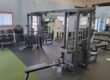
| Step into almost any commercial gym or fitness space at 6:00 PM and you’ll notice the main bottleneck isn’t always the treadmills, but right in front of the dumbbell rack. Three people waiting for the same pair of mid-range weights, two adjustable benches angled across the walkway, and loose weight plates turning into trip hazards near the free-weight area. |
 |
| Rethinking Footprint vs. Training Variety
Free weights remain a core pillar of any strength floor, yet a standard rack looks far more compact on paper than it is in practice. Once you place two adjustable benches in front of it and add the required safety clearance so members can pick up weights comfortably, a basic free-weight station easily takes up 97 to 118ft2 of usable floor space.
For boutique studios, corporate wellness spaces, hotels, and mid-sized gyms, balancing that free-weight zone with dual-adjustable pulleys and multi-stations keeps traffic moving smoothly during busy hours:
|
Biomechanical Differences: Continuous Tension vs. Gravitational Load
To specify the right equipment mix for a project, the first step is looking at how resistance behaves in each category. Free weights, whether dumbbells, Olympic barbells, or kettlebells, rely strictly on gravity. They always pull straight down, meaning the muscle tension changes throughout the movement depending on joint angles and leverage.
Since free weights move in any direction, they require you to use smaller muscles to maintain balance and posture. That’s why they’re great for compound exercises like squats, deadlifts, and overhead presses, where the whole body works together.
Cable machines, on the other hand, use weight stacks, pulleys, and coated steel cables to redirect resistance across horizontal, diagonal, and vertical planes. Unlike dumbbells, a multi-station with adjustable pulleys maintains constant mechanical tension from the start of the movement to peak contraction, regardless of the direction of gravity. Users can perform core rotations, unilateral presses, and specific joint angles safely without needing someone nearby to help rack or unrack heavy loads.
Operational Area: Calculating Exercises per Square Meter
When comparing equipment on a floor plan, the physical dimensions of the frame tell only half the story. A standard commercial rack for 10 pairs of dumbbells is about 8 feet wide by 2 feet deep, taking up less than 22 ft² on paper. As soon as you place two adjustable benches in front of it and reserve a mandatory 5 foot clearance so members can grab weights without bumping into someone mid-set, that basic free-weight station easily consumes 100 to 120 ft² of usable floor space.
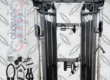
Dual-adjustable pulleys and multi-station towers flip this spatial math. A commercial dual-pulley station occupies around 16 to 18ft² of physical base, plus a 5 foot working zone in front of the columns, totaling about 60 to 75ft² of active operational area. Within this compact footprint, one or two users can perform over forty upper-body, lower-body, and core exercises simply by sliding the pulley carriage height and swapping handles.
When a project demands even higher user traffic, multi-station towers concentrate lat pulldowns, seated rows, triceps pushdowns, and adjustable crossovers into a single central island. Instead of scattering six individual machines across the room with separate walkways around each one, a multi-station island lets multiple users train simultaneously while keeping pathways open.